
As every horse owner knows, wounds and injuries in horses can occur with surprising frequency. No matter how careful riders and keepers are, some horses just seem to be more accident prone than others! Manging wounds, therefore, is something most owners will have to deal with at some point.
What should I do if my horse has a wound?
In the first instance, it is always worth asking for veterinary advice in the case of any wound, as sometimes even small, seemingly insignificant wounds may be more serious than they first appear. Initial first aid is one of the most important steps in wound management. The wound should be cleaned thoroughly and assessed to make sure that no important structures, like joints or tendon sheaths are involved.
What can go wrong with wounds in horses?
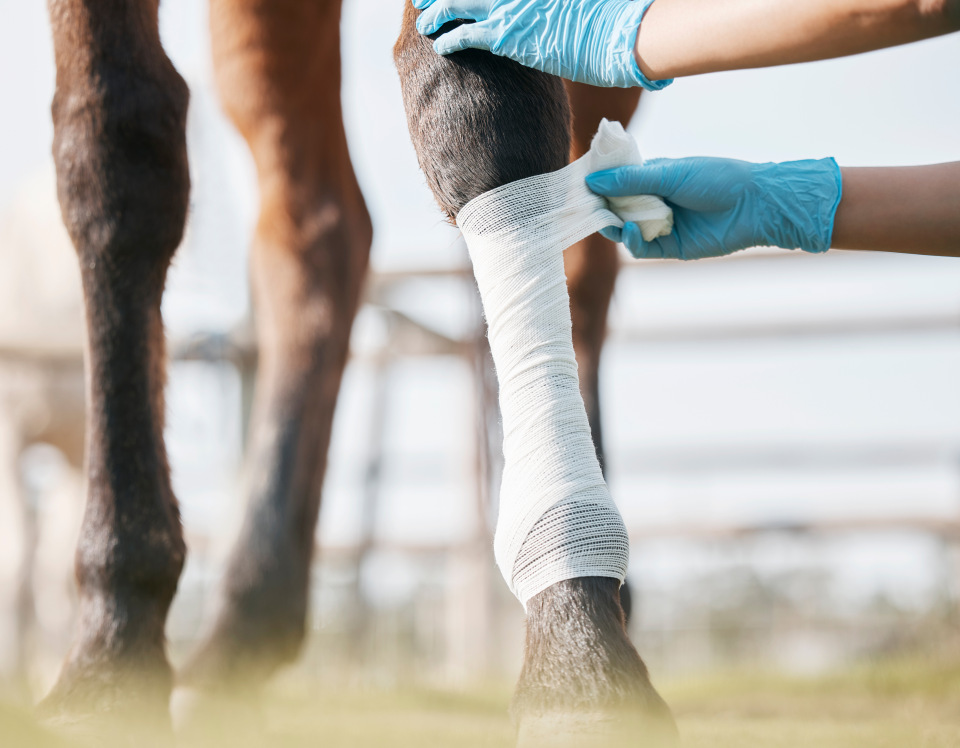
Wounds in horses, particularly those on the limbs, often heal poorly in comparison to other species, due to the fact that they have relatively poor blood supply to the lower limb, as well as little muscle and soft tissue covering the bones. In addition to this, horses are prone to the development of proud flesh, where healing granulation tissue grows above the level of the skin, preventing the edges of the wound from closing over. It can also be challenging to bandage some areas, like the body or face, effectively. Other factors that can contribute to a delay in healing include contamination with bacteria or dirt, movement and self-trauma.
How can wounds be treated?
There are a huge variety of topical wound treatment options available, with some more suitable than others. Topical treatment is especially useful in cases that cannot be bandaged. Ideally, topical treatments should be well tolerated, provide a barrier to infection and contamination and provide the optimal environment for wound healing.
Cuvestrequin can help
At Clarendon Equine, we have started to use a new topical treatment called Cuvestrequin with some very promising results. Cuvestrequin has only recently been made available on the market. It is a topical gel barrier, made up of a polymer, combined with copper salts in an ethanol base. The ingredients are all approved as safe for use, and it is specifically designed for use in horses.
How does Cuvestrequin work?
Once applied to the skin, it forms a waterproof and water repellent barrier which protects the wound from mud and dirt as well as a physical barrier to flies. It also creates a surface that bacteria cannot adhere to, which helps to reduce the risk of infection. As this is a gel, it adheres well to the surface of the skin, which means that it is suitable for use in areas where bandages would normally slip or rub.
Perhaps one of the most attractive qualities of the gel is that it does not contain antibiotics or steroids. We are very keen as a practice to reduce the amount of antibiotics we use, to reduce the risk of antimicrobial resistance which could render some antibiotics less effective for everyone. In addition, steroids may not be suitable for use in some of our patients, so we are confident that this treatment is safe to use in most cases.
How is Cuvestrequin used?
In the first case, the wound should be clipped and cleaned as normal, so that dirt and debris are removed. The skin should be dry before applying the product. A thin layer is usually spread gently over the wound, where it dries quickly. It will then set into a harder film. Once applied, it usually remains in place for 24-72 hours. In time, it will dry and flake off, or you can brush it off with a clean, stiff brush. It can be reapplied every 24-48 hours, as necessary. If the wound is particularly moist or oozing, the Cuvestrequin allows this to drain out, without washing away, so it will still protect the wound.
Horses can continue in light work while the gel is being used, unless the wound is likely to cause a rub or other issue. The gel is suitable for most areas on the body but can cause eye irritation if applied in that area.
In summary, we have found the gel to be a safe, effective treatment that is easy to use and well tolerated in a number of cases. If your horse has a wound that you feel may benefit from treatment with Cuvestrequin, please contact us to discuss.